
What is Osteoporosis/Osteopenia?
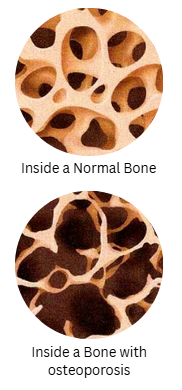
Osteoporosis is a disease characteried by decreased bone density and strength, resulting in bones that are thinner and more fragile.
Osteopenia refers to a reduction in bone mass that is less severe than osteoporosis.
As bone density decreases, the risk of fragility fractures increases due to weakened bone strength.
Adding exercise and supplements to your regular daily routine will help manage your osteoporosis by slowing bone loss and strengthen your muscles to support bones.
What Type of Exercises Should You Add?
Strength Exercises
This includes movements where you are working against resistance, e.g. exercise bands, free weights or lifting your body weight against gravity.
Strength exercises should be preformed 2 or 3 times a week.Impact Exercises
This includes activites where both feet leave the ground or significant force is applied to the joints, e.g. jumping jacks, jump rope, zumba.
Impact exercises should be preformed 2 or 3 times a week.Posture Exercises
These exercises work on the muscles in your back that help you stand and sit straight.
Posture exercises should be preformed everyday.Balance & Coordination Exercises
These exercises are made to challenge your balance and coodination to then improve them, leading to better balance & fall prevention.
Balance & coordination exercises should be preformed everyday.Flexibility Exercises
This includes stretching to limit tight and stiff muscles resulting in your body being able to move through movements with less restriction caused by tight muscles.
Flexibility exercises should be preformed everyday.Aerobic Exercises
This includes any continuous, rythmic activity that you do without resting at a Moderate to Vigorus intensity to help improve overall health/heart health.
Aerobic exercises should be performed for a total of 150min a week (approx. 20-30min per day)
Moving Safely with Osteoporosis
When you are bending and lifting ensure you bend using your hips and knees instead of bending with your beck.
Things to Avoid when Bending and Lifting
Avoid lifting heavy objects overhead
Bending all the way forward
Repetitive bending or twisting
Bending or twisting while holding a heavy object
For further information or to get assistance with managing your Osteoporosis, book an appointment with us and we can help get you started!
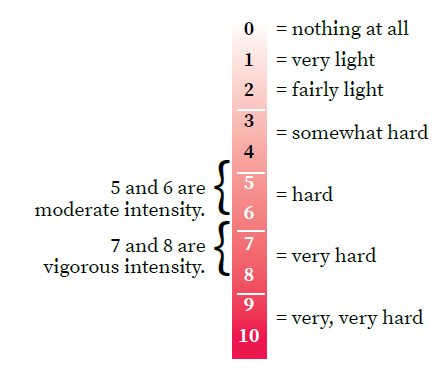
Rate of Perceived Exertion (RPE) scale